
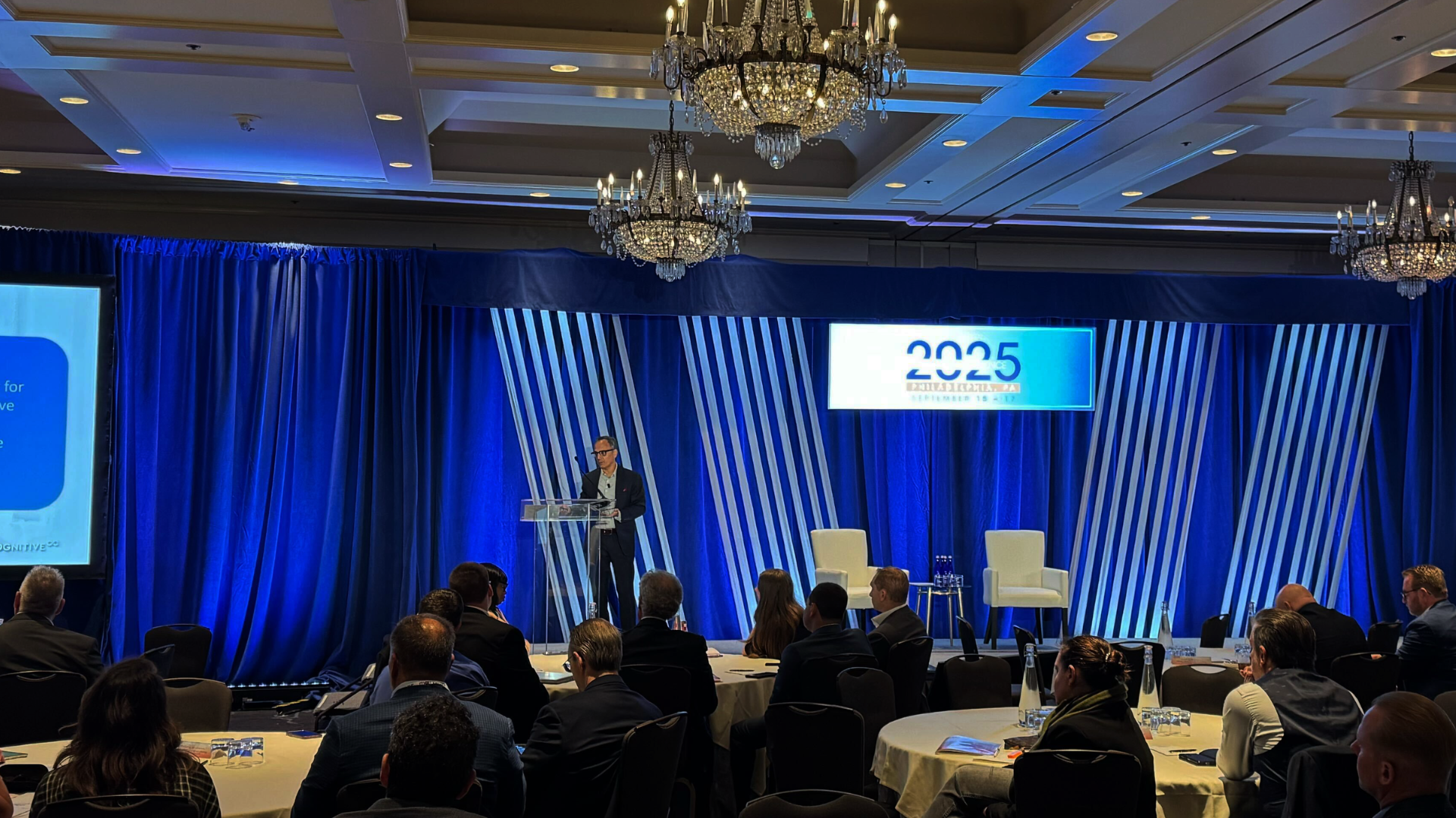
2025 was a defining year for Cognitive. We expanded into the caregiving space, brought Wi-Fi Sensing into new markets, and joined industry conversations that once felt well out of reach. It was a year of fast movement and meaningful milestones, and it’s worth pausing to reflect on how far the company has come.
In this first part of our review, we sat down with our CEO, Dr. Taj Manku, for a candid conversation about what stood out, what surprised him, and what shaped Cognitive’s path in 2025. Part 2 will look ahead to 2026 and explore what’s next for the company and the industry.
Q: 2025 has been a milestone year for Cognitive and for Wi-Fi Sensing. When you look back, what stands out most?
Taj: This was the first year where Wi-Fi Sensing for caregiving truly started being a product category people could hold, use, and rely on. We officially launched Caregiver by Cognitive — not a pilot, not a proof-of-concept, but an actual commercial, in-market solution. At the same time, WiFi Motion continued to scale and is now deployed in more than 20 million homes, which shows just how far sensing has come as a mainstream capability. For years we refined the signal processing, validated the models, and talked about what was possible. This year, we delivered it at scale. We also showed up in the places where proactive care is taking shape: emergency response, in-home support, and the broader ecosystem of aging and independent living. Events like the MAMA National Conference (now the Connected Health & Safety Association) and the UK-Chamber launch made one thing clear: once people see Wi-Fi Sensing in action, they immediately understand the value. And of course, there were two major milestones that speak to the maturity of the field:
- The 802.11bf standard was finalized, formally bringing sensing into the IEEE 802.11 framework that underpins Wi-Fi worldwide.
- And Cognitive crossed 400 awarded patents, which says a lot about the depth of our technical foundation.
Looking back, it feels like the year the groundwork finally connected with the world asking for it. Q: Wi-Fi Sensing is still young. What was the biggest leap forward this year in awareness or adoption?
Taj: Without question: the 802.11bf standard. It essentially formalized what we’ve been pioneering for years. Now, sensing features will be built directly into next-generation Wi-Fi chipsets. That means scale, interoperability, and global momentum. Wi-Fi Sensing won’t be a specialty capability anymore but an expected one.
Q: Cognitive’s partnerships span chipset makers, service providers, and care organizations. How have these influenced what the technology can do?
Taj: Deeply. Our partners in the caregiving space have given us direct visibility into what happens in the field — not the theoretical version, but the human one. They tell us what’s confusing for caregivers, what’s clinically meaningful, what’s burdensome, and what’s genuinely helpful. That feedback is invaluable. It shapes our roadmap, keeps the software focused on real outcomes, and ensures we’re not building features in isolation from the people who will use them.
Q: Caregiver grew out of your own family’s needs. How has using the product yourself influenced how you lead and build?
Taj: Using your own software in your parents’ home is humbling. You see every friction point. Every moment where something could be simpler. Every situation where clarity matters more than cleverness. So much of the technology behind Caregiver has advanced since the day I first installed it for my parents. That wasn’t an accident — it came from real conversations with people, like my own parents, who don’t want their homes redesigned in the name of safety. It’s made me more patient, more empathetic, and more focused on how I can combine both technical accuracy and emotional reassurance.
Q: What moment made you proudest of your team?
Taj: Seeing the full commercial release of Caregiver come together. Software like ours isn’t simple. You’re merging signal processing, physics, machine learning, real-world home environments, edge deployments — and then you layer on the emotional and practical realities of caregiving. Watching the team align all of that into a polished, dependable product was extraordinary. There’s no shortcut to that kind of execution. It took cooperation, humility, and a lot of quiet problem-solving that most people will never see. That’s what made me proudest.
Q: What feedback from families or care providers this year stuck with you?
Taj: The consistent feedback is how simple the installation feels — and how that simplicity lowers the emotional barrier to adopting safety tools. People compare it to older solutions like PIR sensors and immediately see the difference. PIR requires installers, precise placement, and often a physical disruption to the home. Our sensing software activates from a small plug paired with the router’s existing Wi-Fi signals. Families appreciate that. Care organizations appreciate that. The other thing I hear often is that Caregiver feels affordable in a category that rarely feels affordable. That matters. You can’t talk about aging with dignity if the tools require a financial sacrifice families can’t make.
Q: What did you learn running Cognitive this year?
Taj: That disciplined focus is harder than innovation — but just as important. We have more opportunities than capacity, so we’ve had to be intentional about who we partner with, which markets we pursue, and where we invest our technical resources. Sometimes that means saying no to attractive opportunities because they don’t create long-term value. Growth takes time. Alignment takes patience. But both are worth the effort.
Q: What advice would you give to entrepreneurs building technology meant to improve people’s lives?
Taj: Be prepared for the work to be harder — and more meaningful — than you expect. There are more setbacks than breakthroughs in the early years. You need resilience, a clear sense of purpose, and a willingness to adapt when reality doesn’t match the original plan. The transition from idea to production always reveals challenges you couldn’t have predicted. But if you’re building something you know could genuinely help people, that purpose becomes your anchor. It keeps you steady through the difficult stretches and makes the wins feel incredibly rewarding.
Q: Finally: You often say Cognitive is “just getting started.” What did 2025 reinforce about the potential of the technology — and the team?
Taj: I think the biggest realization was how ready the caregiving ecosystem is for proactive insight. For years, we’ve seen a market dominated by reactive tools — emergency buttons, alerts, event-driven devices. When we introduced Caregiver, people immediately understood that continuous, unobtrusive insight is the gap they’ve been waiting to fill. At the MAMA conference, people flocked to chat with us about it. Many weren’t asking basic questions like “What is Wi-Fi Sensing?” anymore. They were asking, “How quickly can we deploy this?” That shift told me a lot about where the industry is headed. On the technology side, the platform matured significantly — higher deployment volumes, stronger modeling, and more sophisticated algorithms. It showed us that Wi-Fi Sensing can be both lightweight and extremely powerful when implemented well.