
Resources

Validating Activities of Daily Living with Wi-Fi Sensing and Data Fusion
The biggest challenge in modern eldercare is an overflow of data with a lack of clarity. Homes today are filled with smart devices generating endless signals: a motion detector blinks, a fridge door opens, a smart plug activates. But what does any of it actually mean?...
Validating Activities of Daily Living with Wi-Fi Sensing and Data Fusion
Today’s connected homes are full of smart devices — but data without context can overwhelm more than it helps. In eldercare, the difference between a light turning on and a meal being made can mean everything. This blog explores how Wi-Fi Sensing and data fusion bring clarity to that noise, transforming fragmented signals into validated insights about Activities of Daily Living (ADLs).
Filter by topic

How Can Wi-Fi Sensing Improve Secondary Verification?
The U.S. Department of Justice reports that 94-98% of police responses to security alarms are false, costing over $1 billion annually. False alarms, triggered by non-threatening events like shadows or pets, lead to unnecessary police dispatches, operational inefficiencies, fines, and customer dissatisfaction. Secondary verification, which uses multiple data points to confirm alarms, addresses this by reducing reliance on single sensors and minimizing errors. AVS-01, a standard by The Monitoring Association, mandates procedural verification steps to ensure alarm reliability, utilizing data from multiple sensors, video, and audio systems to categorize alarms by priority. Wi-Fi Sensing enhances secondary verification by detecting motion through Wi-Fi signal disruptions, confirming human presence and reducing false alarms. It integrates easily into existing systems, enhancing reliability without complex installations. Advanced algorithms further refine motion detection, filtering out non-threatening movements. This technology streamlines threat detection, improves response times, and boosts customer trust in security systems.

How Will Wi-Fi 7 Impact Wi-Fi Sensing?
Oleksiy Kravets, CTO & Co-Founder of Cognitive, outlines the transformative impact of Wi-Fi 7 on Wi-Fi Sensing technology. Wi-Fi 7, the upcoming standard set for ratification in 2024, promises carrier-class reliability and performance crucial for ISPs and telcos, aligning with customer expectations. Key features like MU-MIMO, LDPC, OFDMA, and a new frequency band herald improved efficiency, speed, and security. These advancements are poised to revolutionize Wi-Fi Sensing, enhancing responsiveness, coverage, reliability, scalability, and precise localization. With Wi-Fi 7's imminent adoption and partnerships with chipset manufacturers, the future of Wi-Fi Sensing looks promising, offering unparalleled levels of accuracy and responsiveness by leveraging Wi-Fi 7's cutting-edge capabilities.

Electronic Caregiver, Inc. Partners with Cognitive Systems Corp. To Offer AI-Based Ambient Assisted Living Sensing
Electronic Caregiver, Inc. has partnered up with Cognitive Systems Corp. to introduce CareAware™, a WiFi Motion-based sensing solution for older adults in the United States. This partnership aims to enhance aging-in-place experiences by using wireless signals to monitor daily activities discreetly. The technology offers real-time insights for proactive monitoring and personalized care plans, supporting seniors' desire for independent living. This collaboration represents a significant advancement in caregiving technology, providing valuable data and peace of mind for caregivers and seniors alike.

Transforming Healthcare: Caregiver by Cognitive Sets New Standards in Health Tech
Cognitive is thrilled to introduce Wi-Fi Sensing for caregiver licensing, offering eldercare companies a chance to boost SaaS revenue by adopting our cutting-edge caregiver solution. Our WiFi MotionTM technology enhances accessibility for wellness providers, enabling seamless integration into client devices. With real-time insights, privacy safeguards, and comprehensive monitoring capabilities, our solution is poised to revolutionize proactive health monitoring while promoting dignity and independence. Join us in transforming caregiving and discover the benefits of WiFi Motion for Caregiving by contacting [email protected] or downloading our whitepaper.
Can Wi-Fi Sensing Help Elderly and Disabled People Live at Home Independently?
Saibal Chakraburtty, Cognitive's Director of Product Management, recently engaged in a conversation with Chris Lewis from Lewis Insight and Monica Paolini from Senza Fili. They delved into the potential applications of Wi-Fi Sensing in eldercare and aging-in-place scenarios, aiming to support both independent living and overworked caregivers. The discussion highlighted the ease of deploying Wi-Fi Sensing for seniors through internet-connected devices like smart plugs, speakers, and sensors. This technology allows caregivers to monitor the movements of elderly individuals, assess problem areas, track daily activities, and receive early warnings of potential health risks such as changes in sleep habits or increased sedentary behavior. Ultimately, Wi-Fi Sensing seeks to provide peace of mind to caregivers and family members while enabling elderly individuals to maintain their independence at home.
The Science Behind Wi-Fi Motion Sensing with Dr. Taj Manku
In the Interesting Engineering podcast, Cognitive's CEO, Dr. Taj Manku, discusses the transformative role of Wi-Fi technology, highlighting its evolution from laptops to IoT devices and its impact on modern connectivity, while also introducing Wi-Fi Sensing for privacy-focused security without cameras.

Enhancing Home Security: The Power of WiFi Motion
Explore how Cognitive's WiFi Motion technology transforms home security offerings, enhancing customer satisfaction and revenue growth by seamlessly integrating motion sensing into existing systems. Learn how WiFi Motion complements DIY solutions, streamlines professional services, and introduces new tiers of security, optimizing security measures while reducing operational costs.
More Options with Wi-Fi Sensing for Client Devices
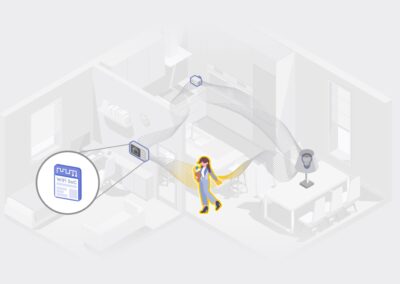
Discover how the integration of WiFi Motion into client device chipsets is revolutionizing Wi-Fi Sensing, expanding possibilities beyond traditional AP-centric setups. Explore the implications for smart homes, security, healthcare, and more, as technology evolves to intuitively respond to users' presence and movements.
Wi-Fi Sensing: Transforming Connectivity into Intelligent Insights
In a recent TechInsights interview, Cognitive's EVP of Sales, Bob El-Hawary, highlighted the transformative potential of Wi-Fi Sensing, showcased through Cognitive's WiFi Motion™. TechInsights sees Wi-Fi sensing as a future essential in smart spaces due to its versatility and privacy features. The technology is expected to integrate with emerging tech like UWB and ultrasonic sensors. Cognitive envisions Wi-Fi Sensing evolving beyond communication, seamlessly integrating with various innovations